Showing posts with label inspirations. Show all posts

Monday, 8 July 2013

Museum Curiosities #002

primitive layering. exquisite craft. rigid lace.
metallic grimace. unearthly colour. organic spine.
fallen monument. oceanic whimsy. textural contrast.

Sunday, 30 June 2013

Museum Curiosities #001

layered armor. bottled organisms. crystal formations.
textured filigree. irregular repetition. tribal wear.
delightful smile. natural geometries. eroded line art.

Thursday, 16 May 2013

Sunday, 12 May 2013

Sunday Night Theme


 Hijab. Black Rabbit. Electric Wizard. London Punk. 
Wild Berry


Wednesday, 2 May 2012

Sedna: an Inuit Goddess

In Inuit mythology, Sedna (Inuktitut Sanna, แ“ดแ“แ“‡) is the goddess of the sea and marine animals such as seals. A creation myth, the story of Sedna shows how she came to rule over Adlivun, the Inuit underworld.
A number of versions of the Sedna legend exist. In one legend Sedna is a giant, the daughter of the creator-god Anguta, with a great hunger that causes her to attack her parents. Angered, Anguta takes her out to sea and throws her over the side of his kayak. As she clings to the sides, he chops off her fingers and she sinks to the underworld, becoming the ruler of the monsters of the deep. Her huge fingers become the seals, walrus and whales hunted by the Inuit.
-Wikipedia

The skeleton of Sedna is depicted in the work with techniques inspired by carvings in Ivory from the Inuit tupilak figures. The human side of Sedna shows a more vivid figure expressed through the patterns and fringes covering the garments. Silhouettes inspired by Victorian menswear contribute to the atmosphere of the horrendous story.
-Coute Que Coute


Creation Story. Myth. Underworld. Immortal. Gods. Transformation. Undead. Curse. Cultural Artifact. Corrupted Human Form.
 

Tuesday, 17 April 2012

Sunday, 12 February 2012

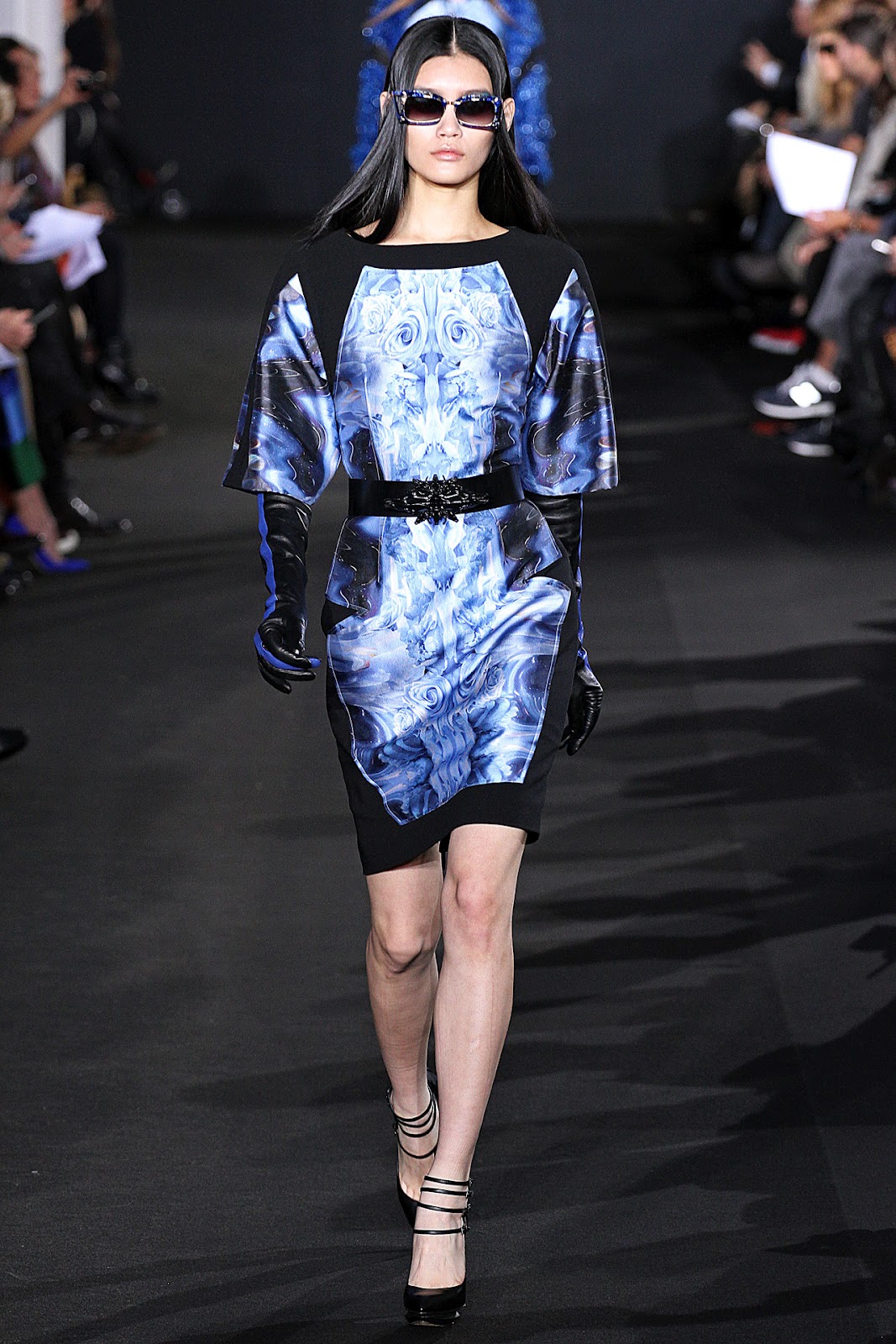
Prabal Gurung AW 2012 + Thoughts on Inspiration

Three seemingly unassociated but equally romantic works—Jan van Eyck’s haunting, religious oil paintings, Georgia O’Keeffe’s famed image of an ethereal, decaying cow skull, and a genetically engineered blue rose were pulled together by the designer into one achingly amorous theme. “I was inspired by the process of creating something new. Part of it was the uncursing of the rose and part of it was spiritual,” explains Gurung. 
-Vogue.com

Always always finding the process of inspiration fascinating. Thinking about it, it would appear that there are three main motivations for design: a woman in a narrative, an object, and for the sake of the garments themselves. 
-
Some collections are designed for a specific person. That collection can tell a story, and the onlooker understands who the woman is. Inspiration may come from a film, a historical person, a celebrity, a book. There is a story. There is a person. Styling, hair and make-up drive home the point. Story tellers: McQueen, Galliano, Dsquared2.
-
Other collections are less obviously created for one woman. They may lack a narrative, and the identity of their woman is less clear. These collections are inspired from everything else in the world: art, photography, architecture, nature, objects, and so on. They look for ideas outside of the fashion world and transform them into clothing. Prabal Gurung is today's example.
-
Finally, there are clothes that are designed to be clothes. They are functional and practical and don't have an elaborate back story that explains their creation. They are designed to fit a need, to be comfortable, to be flattering, to fill a void, to fit a budget, to save on wasted scrap fabric. Less exciting perhaps, but it's no less noble than the other inspirations - just more to the point.


Wednesday, 8 February 2012

A Collection Name

Thinking about inspiration and giving it a name. Labeling garments for archival purposes. History is important.


inside label of a Rick Owens cardigan

page of the Rick Owens book listing his collections' names

Thursday, 5 January 2012

Trompe L'oeil - Part 2

Trompe L'oeil, French for 'deceive the eye', is an art technique involving extremely realistic imagery in order to create the optical illusion that the depicted objects appear in three dimensions.
-Wikipedia


Photocopy. Full Texture. Off-Kilter. Unusual Placement. Unreal. 


Inner Detail. Imprint. Added Construction. Interfacing. Tailoring. Layers.


This McQ dress is especially interesting. One might imagine that the original safety pin covered dress was created and then photographed. That photo would then be transferred onto fabric used to create this basic shift dress. It is the idea of couture made available at a lower price. Ingenious it may be, but couture it is not. New project: recreate this dress but for real. Also: buy many safety pins.

Trompe L'oeil - Part 1

Trompe L'oeil, French for 'deceive the eye', is an art technique involving extremely realistic imagery in order to create the optical illusion that the depicted objects appear in three dimensions.
-Wikipedia


Tracing. Outer Detail. Line Art. Copy Paste. Graphic. Pen and Ink.   
  Partial Detail. Illustrator. Vector. Technical Drawing.
 Top Stitching. Piping. 2D.


Comme Des Garcons AW2009:
http://www.vogue.co.uk/fashion/autumn-winter-2009/ready-to-wear/comme-des-garcons


Rosalind Keep AW2009:
http://rosalindkeep.tumblr.com/